

Why OpEx, AI, and Digital Transformations Fail — And Why Operational Excellence Leaders Are Perfectly Positioned for AI
Dec 10, 2025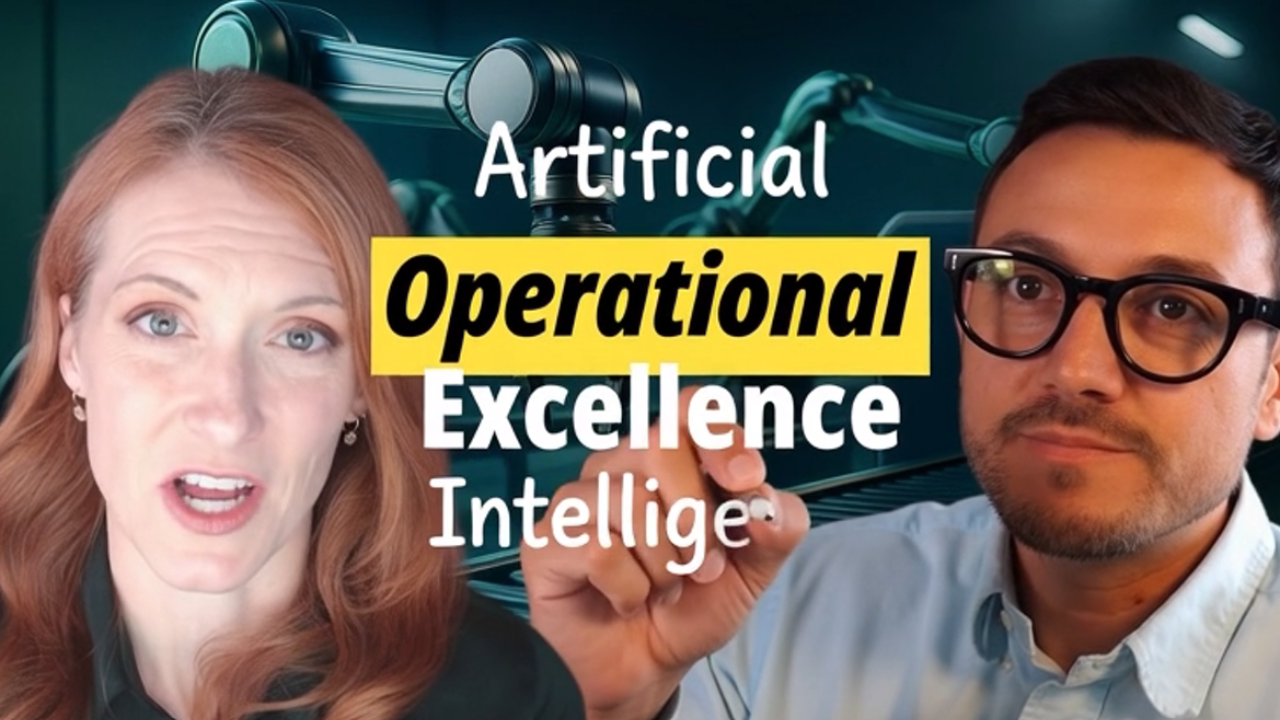
Featuring insights from Jess Orr (ex-Toyota, ex-Corporate OpEx, ex-VP of Operations)
Most companies believe they have technology problems.
In reality, they have culture, leadership, and capability problems — the same problems that have plagued Operational Excellence initiatives for decades.
In this episode of The AI Agency Journey, Antonio Rothenbach sits down with Jess Orr, a continuous improvement leader who has seen transformation from every angle:
-
As a Toyota practitioner working inside one of the strongest improvement cultures in the world
-
As a corporate OpEx leader attempting to unify multiple divisions
-
As a VP of Operations responsible for driving sustainable change
-
As someone who experienced both a successful OpEx transformation and a failed enterprise-wide attempt
What she learned is clear:
AI is not failing because of AI — it’s failing because companies are repeating the EXACT mistakes they made with Operational Excellence.
And that’s why OpEx consultants and CI practitioners are uniquely positioned to guide AI adoption today.
1. What Toyota Gets Right (and Most Companies Don’t)
Jess describes her early Toyota experience as walking into a choreographed system:
-
Standards were clear
-
Problems were visible
-
Leaders taught through presence
-
Everyone participated in improvement
The biggest cultural difference?
Problems were celebrated, not hidden.
Toyota drilled a simple truth into every employee:
“A problem is just the gap between where we are and where we want to be.”
This mindset completely changes how people behave.
Instead of hiding issues, they surface them.
Instead of assigning blame, they search for causes.
Instead of fearing change, they drive it.
When Jess later joined a large manufacturing company that was “10 years into their OpEx journey,” she immediately felt the shock:
-
No standard work
-
Firefighting disguised as “normal operations”
-
Problems covered up instead of addressed
-
No shared mindset around continuous improvement
Same tools.
Same terminology.
Totally different cultural foundation.
This is the heart of why OpEx efforts fail — and the same reason AI efforts collapse today.
2. Why OpEx Transformations Fail (and AI Efforts Are Failing for the Same Reason)
Most organizations and consultants take a tools-first approach:
-
“We’re rolling out 5S.”
-
“We’re doing Kaizen events.”
-
“We’re implementing Daily Management.”
-
“We’re doing an AI pilot.”
-
“We’re deploying automation.”
Jess and Antonio emphasize:
When you pick tools before understanding the problem, you guarantee failure.
Because tools don’t change culture.
Tools don’t create ownership.
Tools don’t align leadership.
Tools don’t sustain themselves.
Companies loved the templates, the toolkits, the dashboards.
But the conditions for success were never created.
Jess says it best:
“People gravitate toward tools because culture is harder. It’s harder to wrap your arms around. So they skip it.”
AI is suffering from the exact same dynamic:
-
Deploying pilots without clarity
-
Automating without understanding flow
-
Chasing trends instead of solving constraints
-
Buying technology before building capability
-
Expecting results without involvement
The result?
No ROI. No adoption. No sustainability.
Sound familiar?
3. The Leadership Mistake That Kills Both OpEx and AI
Jess witnessed a company rollout of a daily management system (DMS) across 300 sites.
Corporate built a standardized template — even preprinted boards — and demanded every site use it.
It looked good on paper.
It failed in practice.
Why?
Because:
-
Sites with mature systems were forced backward
-
Sites with weak capability couldn’t support it
-
Local ownership disappeared
-
The why was never aligned
-
Leadership style became “telling” instead of “teaching”
In contrast, Toyota leaders practiced Genchi Genbutsu — go and see.
They didn’t sit in conference rooms designing solutions.
They went to the floor, observed reality, challenged assumptions, and helped people think.
Jess’s advice:
“If you’re stuck, go see. Reset your understanding. Challenge your assumptions.”
This is precisely the leadership mindset missing in today’s AI initiatives.
4. Why Consultants Fail — And How They Should Be Used
Both Antonio and Jess lived through years of consultant-led transformation.
They both saw the same pattern:
❌ Where consultants fail:
-
The company becomes dependent on them
-
Internal capability is not built
-
Gains disappear when the consultant leaves
-
No structure exists to upskill the next generation
-
“Train the trainer” becomes a checkbox exercise
✔️ Where consultants succeed:
-
When they coach an internal champion
-
When they are paired with site leaders
-
When they transfer mindset, not tools
-
When the goal is not just impact, but sustainability
Jess’s approach was clear:
“The consultant’s job is to mentor internal capability so that you don’t need the consultant anymore.”
Without this, transformation only lasts as long as the contract.
And this is where AI consulting is currently failing — badly.
Companies are buying models, automation tools, hype, and dashboards…
But not capability.
5. Why OpEx Consultants Are Perfectly Positioned to Lead AI
This is the central message of the episode.
OpEx and CI consultants:
-
Start with the problem, not the tool
-
Know how to map processes
-
Understand constraints and flow
-
Are trained in root cause analysis
-
Build internal capability
-
Coach leaders on thinking, not just tools
-
Are experts in cultural adoption
-
Know how transformations die
And they’ve lived through years of organizations:
-
Resisting change
-
Misunderstanding tools
-
Blaming people
-
Misaligning leadership
-
Skipping culture
-
Expecting miracles without investment
You are already 80% prepared to lead AI adoption — more than data scientists, engineering teams, automation firms, or tech vendors.
AI is just another wave of improvement.
A powerful one — but still just a wave.
Your OpEx brain is the operating system needed to make AI stick.
6. Introducing the AI Business Audit: A Natural Extension of OpEx Thinking
Antonio explains how the AI Business Audit works:
-
Identify constraints and bottlenecks
-
Map the current state
-
Use AI with the team to brainstorm solutions
-
Validate feasibility
-
Calculate ROI
-
Build a 90-day roadmap
-
Prioritize based on value, impact, and capability
This is literally value stream thinking — augmented with AI.
Jess’s reaction?
She loved it.
Not because it was shiny or trendy.
But because it applied the same discipline and logic that Toyota uses:
-
Understand the problem
-
Surface the gap
-
Find solutions collaboratively
-
Build capability
-
Sustain improvements
This is why OpEx consultants are the ones who should lead AI — not react to it.
7. A Message to OpEx & CI Consultants: This Is Your Moment
If you’ve spent years leading:
-
Kaizen
-
Lean
-
Six Sigma
-
TPM
-
DMS
-
Standard Work
-
Value Stream Mapping
-
Leadership coaching
…then you are exactly who organizations need for AI transformation.
The world is shifting fast.
Most companies don’t know where to start.
They are repeating the mistakes of the last 20 years.
And the only people trained to prevent that are people like you.
You can:
-
Partner with AI specialists
-
Apply the OpEx mindset
-
Guide teams through change
-
Help leaders adopt systems thinking
-
Identify real, high-ROI opportunities
-
Prevent culture damage
-
Create sustainable capability
The world needs OpEx-led AI, not IT-led AI.
Want to Partner with Antonio on AI Business Audits?
Ibero AI runs AI Business Audits specifically designed FOR OpEx consultants and CI practitioners.
➡️ You bring the relationship; we bring the AI frameworks.
➡️ Together we deliver transformational value to your clients.
Book a 45-minute demo to see how it works:
👉 https://calendar.app.google/r5XFrizEn1SJ1rH67
Final Thought
Transformation — whether Lean or AI — does not fail because tools are wrong.
It fails because leadership is unprepared, capability is missing, and culture is ignored.
OpEx has already learned these lessons.
Now it’s time to apply them to the next frontier.
Did you find this content useful? If you did, you will probably find value in the FREE Tools, Templates, and Mini-Courses we provide to empower you to be successful in your career journey!
Stay connected with news and updates!
Join our mailing list to receive the latest news and updates from our team.
Don't worry, your information will not be shared.
We hate SPAM. We will never sell your information, for any reason.
